Malta
Student Stipends in Malta: Who Gets Them, How Much, and When
Malta student stipend rates for 2026-27 after the 15% rise, who qualifies, the application window and the ten payment dates, from the official source.
On this page
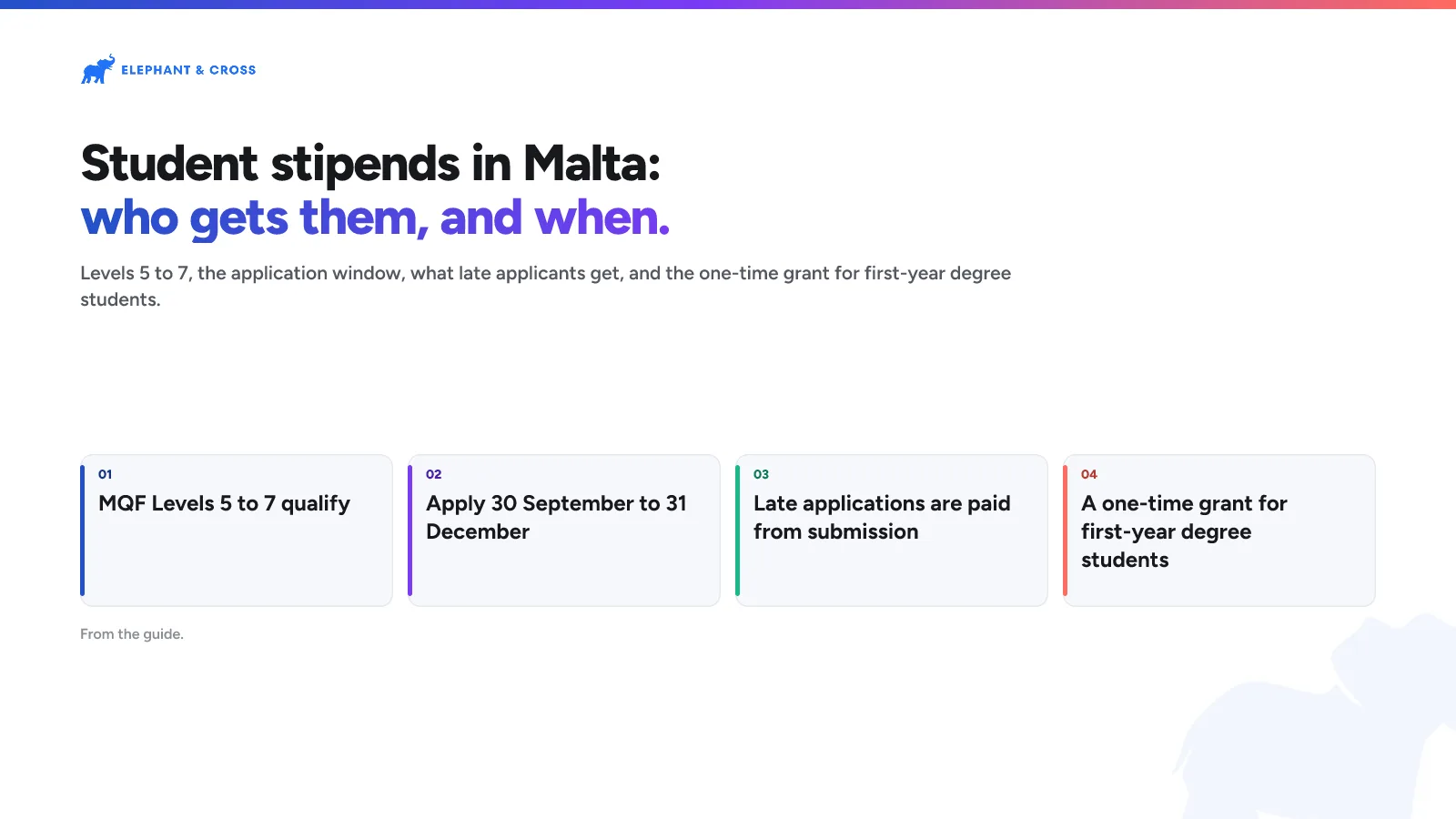
Malta pays a stipend to full-time students at approved post-secondary, vocational and university courses: in 2026-27 that is €135.93 every four weeks for most courses, €228.14 for prescribed courses and €444.59 for high-priority degrees, ten payments a year, plus a yearly grant of €332.94 to €798.81, after the 15% rise paid from 25 February 2026. Apply between 29 September and 31 December 2026 to be paid from the start of the year.
This guide gives the rates, the dates and the rules as the Students’ Maintenance Grants Unit published them on 29 September 2026, and says plainly who does not get a stipend: a working adult on an online course. For that reader the scheme that matters is Get Qualified, which pays back 70% of the fee.
Who qualifies for a stipend
Stipends and grants are regulated by Subsidiary Legislation 605.06 and run by the Students’ Maintenance Grants Unit. You qualify if you are a Maltese citizen or have a Maltese parent, an EU or EEA national with permanent residence in Malta or exercising Treaty rights here, or a third-country national with refugee or long-term residence status. On top of that you must:
- have lived in Malta for the five years immediately before the course started (time abroad for medical or other approved reasons can be exempted);
- have completed compulsory education;
- attend regularly and make satisfactory progress;
- not be in full-time employment. Part-time work of up to 30 hours a week is allowed;
- be progressing to a higher level on the Malta Qualifications Framework than the one you already hold.
The course has to be at an approved institution: the post-secondary schools, MCAST, the University of Malta and the other institutions on the Unit’s list. A master’s degree only carries a stipend if it leads to a professional warrant.
How much you get, 2026-27
The amounts depend on the level of the course and its classification. “Prescribed” and “high priority” courses are the ones the government lists as national workforce priorities, and they pay more. All figures below are the rates in force since March 2026, which include the 15% rise.
| Course | MQF level | One-time grant | Yearly grant | Stipend, ten payments |
|---|---|---|---|---|
| Post-secondary courses | 3 to 4 | None | €332.94 | €135.93 each |
| MCAST vocational courses | 1 to 3 | None | €332.94 | €135.93 each |
| MCAST advanced diploma, general | 4 | None | €332.94 | €135.93 each |
| MCAST advanced diploma, prescribed | 4 | €698.81 | €798.81 | €228.14 each |
| MCAST higher or undergraduate diploma | 5 | None | €565.87 | €135.93 each |
| MCAST degree, general | 6 | €465.87 | €565.87 | €135.93 each |
| MCAST degree, prescribed | 6 | €698.81 | €798.81 | €228.14 each |
| University of Malta certificate | 4 | None | €332.94 | €135.93 each |
| University of Malta diploma | 5 | None | €565.87 | €135.93 each |
| University of Malta degree, general | 6 | €465.87 | €565.87 | €135.93 each |
| University of Malta degree, prescribed | 6 | €698.81 | €798.81 | €228.14 each |
| University of Malta degree, high priority | 6 | €698.81 | €798.81 | €444.59 each |
| University of Malta master’s, general | 7 | None | €565.87 | €135.93 each |
| University of Malta master’s, prescribed | 7 | None | €798.81 | €228.14 each |
| University of Malta master’s, high priority | 7 | None | €798.81 | €444.59 each |
Over a year the standard stipend comes to €1,359.30, the prescribed rate to €2,281.40 and the high-priority rate to €4,445.90, before the yearly grant. Students who are single parents on social security benefits, apprentices and students in proven hardship can get more: a single parent’s grant set by the level of the course, summer and top-up stipends for apprentices so that the year’s income reaches the national minimum wage, and a supplementary allowance decided by the Students’ Maintenance Grants Board.
The 15% rise
Budget 2026 raised every stipend and supplementary stipend by 15%. The rise took effect with the payment of 25 February 2026, which paid the last days of December at the old rate and January at the new one. The government put the cost at €6 million a year for around 16,600 students.
Budget 2027 is presented on 26 October 2026. If it changes the rates or the classifications, this page will carry the new figures the next morning.
The dates for 2026-27
Apply online with your e-ID between 29 September and 31 December 2026 to be paid from the start of the academic year. An application made after 31 December is still accepted, but it pays from the date you submit it. Applications can be amended until 30 June 2027 and nothing is processed after that date. Students who have been promoted to the next year confirm their details in the same window.
Stipends are paid every four weeks into the bank account on your application, after your institution confirms that the course has started and you have confirmed the application online. No alert is sent when a payment lands.
| Payment | Date |
|---|---|
| 1 | 2 December 2026 |
| 2 | 30 December 2026 |
| 3 | 28 January 2027 |
| 4 | 25 February 2027 |
| 5 | 25 March 2027 |
| 6 | 22 April 2027 |
| 7 | 20 May 2027 |
| 8 | 17 June 2027 |
| 9 | 15 July 2027 |
| 10 | 12 August 2027 |
| Third semester and apprentices only | 9 September, 7 October and 4 November 2027 |
How to apply
The application is four pages on stipendsandgrants.gov.mt and takes about ten minutes once your documents are scanned.
- Personal details. Check them and enter your IBAN; a wrong IBAN is the usual reason a payment does not arrive.
- Course and history. Your course details and at least one entry in your education or employment history.
- Supplementary allowance. Only if you are in proven hardship or a humanitarian situation; pick the reason.
- Documents. Your recent employment history, your school-leaving certificate and profile, and the full certificate or diploma you already hold. For the supplementary allowance, add your parents’ employment history, their FS3 forms, social security statements and any profit and loss declaration.
Submit, then confirm the application online once the institution has confirmed your attendance.
Studying online around a job? This is not your scheme
A stipend is for a full-time student at an approved Maltese institution. If you work full time, or you are taking a UK diploma online, you do not qualify: full-time employment rules you out, and the course is not on the approved list. The scheme for you is Get Qualified, which pays back 70% of what you paid for an accredited course as a tax credit, for any award attained from 1 January 2026, applied for within 12 months of finishing. On a Level 5 diploma at €220 a month that is most of the fee back. The two schemes do not overlap: a stipend goes with full-time study at a Maltese institution, the tax credit with a course you paid for yourself.
Frequently asked questions
Can I get a stipend if I work?
Yes, if the work is part time and no more than 30 hours a week. Full-time employment disqualifies you.
Do online courses get a stipend?
No. Stipends go with full-time attendance at an approved institution. For an online diploma or degree you pay for yourself, Get Qualified refunds 70% of the fee.
When is the first payment?
2 December 2026 for the 2026-27 year, provided your institution has confirmed your attendance and you have confirmed the application.
What is a prescribed or high-priority course?
A course the government has classified as a national priority. Prescribed courses pay €228.14 per payment instead of €135.93; high-priority University of Malta degrees and master’s degrees pay €444.59. The classification list is published by the Unit each year.
What if I apply after 31 December?
You are still considered, but the stipend starts from the date you submit, not from the start of the year. You can amend an application until 30 June 2027.
Are master’s degrees covered?
Only master’s degrees that lead to a professional warrant. Other postgraduate courses carry no stipend.
Sources
- Students’ Maintenance Grants Unit, Overview: eligibility, the application, the rates table as of March 2026 and the 2026-27 pay dates. Published 29 September 2026.
- University of Malta, Stipend dates: the 2026-27 payment dates.
- MaltaToday, 24 February 2026: the 15% rise, 16,600 students, €6 million.
- Subsidiary Legislation 605.06, the Students’ Maintenance Grants Regulations.
Last verified: 6 October 2026. Next review: 27 October 2026, after Budget 2027.