Malta
Get Qualified Scheme Malta: How to Get 70% of Your Tuition Fees Back
Get Qualified pays back 70% of an accredited course fee as a tax credit: the 2026 caps by level, the attainment bonus, the 12-month window and how to apply.
On this page
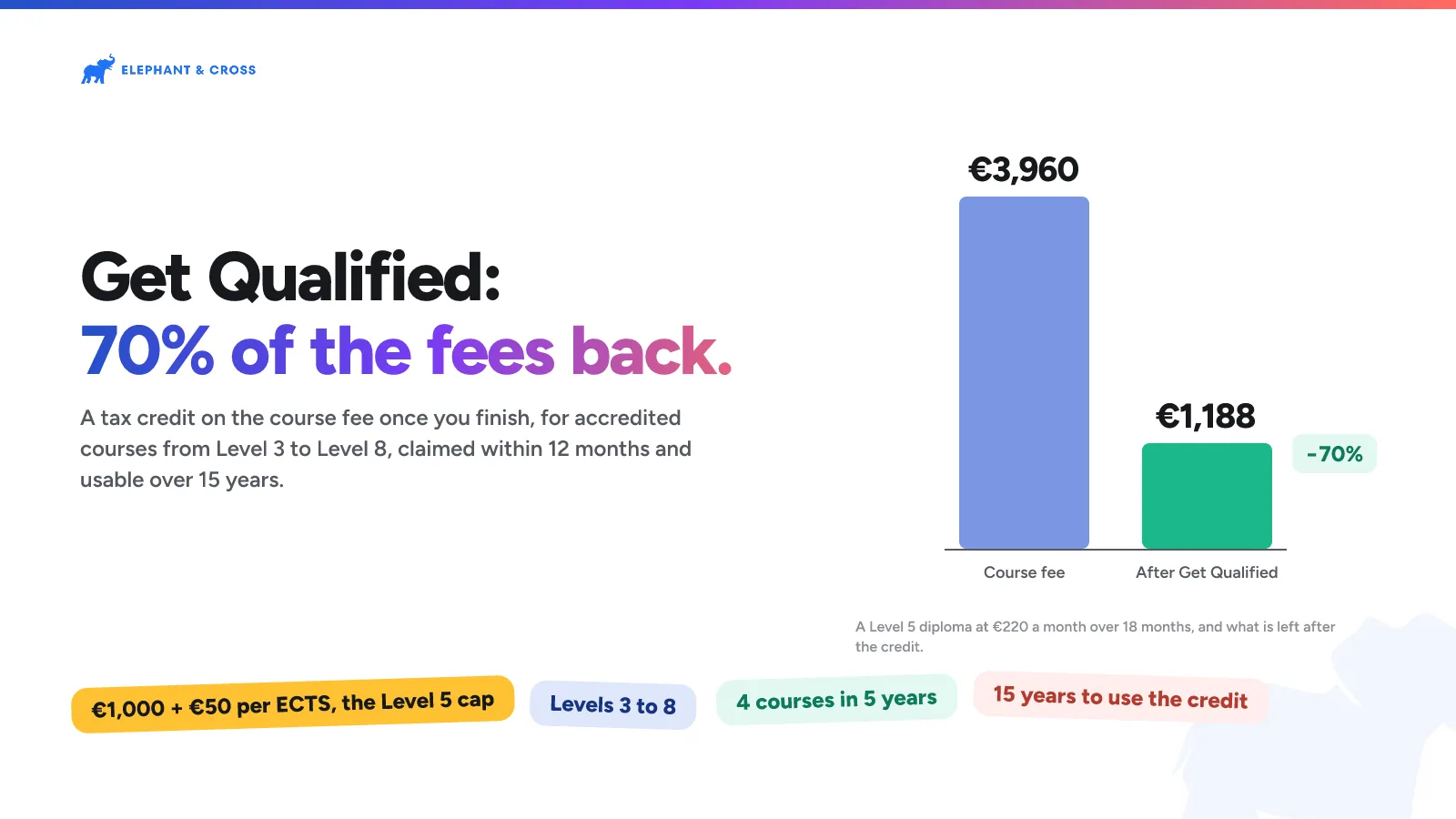
Get Qualified pays back 70% of what you paid for an accredited course, as a tax credit you can use over 15 years. You apply within 12 months of finishing, you can claim for up to four courses in any five years, and the 2026 rules apply to any award attained from 1 January 2026.
Last updated: 6 October 2026. Verified against the Malta Enterprise Get Qualified [2026] Guidance Notes, version 1.0 (1 April 2026), the Malta Enterprise portal, and Newsbook (6 April 2026).
Luca leads education strategy at Elephant & Cross, where his team has helped hundreds of students successfully apply for the Get Qualified scheme since 2020. He specialises in Malta’s qualification frameworks, MQF-accredited course selection, and tax credit planning for working professionals.
The Get Qualified scheme is the Maltese government’s way of paying you back for investing in your education. If you complete an accredited course — anything from a short professional certificate up to a doctorate — Malta Enterprise will refund you 70% of your course fees as a tax credit.
It works like this: you pick a course, you pay for it, you finish it, and then you apply online through the Malta Enterprise portal. Once approved, you get a Tax Credit Certificate that reduces the income tax you owe. If you don’t owe enough tax to use the full credit, you can get the difference back as cash from the tax office. You now have 15 years to use your credit, so there’s no rush.
The scheme was relaunched in April 2026 with bigger benefits: you can now claim for up to 4 courses over 5 years, there’s an extra bonus for STEM subjects, and it covers everything from MQF Level 3 to Level 8 (trade certificates right through to PhDs). You don’t need to be employed — self-employed, unemployed, and students all qualify. The requirements are that you are liable to tax in Malta, started the course after your sixteenth birthday, and have a Government e-ID for the portal.
The most you can get back depends on the level and the size of the course: €1,500 for a Level 3 award, €2,500 at Level 4, €1,000 plus €50 per ECTS credit for a Level 5 diploma (€4,000 for 60 credits, €7,000 for 120), €75 per credit at Level 6, €170 per credit at Level 7, and no cap on a full doctorate. A STEM degree or a master’s adds an attainment bonus of €3,000 to €10,000 on top. The full table is below.
April 2026: Revised Get Qualified Scheme Now Open — Here’s What Changed
On April 6, 2026, Malta Enterprise and Economy Minister Silvio Schembri launched the revised Get Qualified scheme, marking the most substantial update since its introduction. This relaunch strengthens financial support for professional development across Malta, with renewed focus on STEM disciplines to align with Malta Vision 2050 strategic objectives.
If you’ve been considering upskilling or reskilling through accredited courses, this relaunch makes the timing ideal. The scheme now supports up to 4 courses over a 5-year period (up from previous limitations), offers additional fiscal bonuses for STEM studies, and extends credit utilisation to 15 years—giving you unprecedented flexibility in how and when you use your refund.
Whether you’re a working professional, entrepreneur, or job-seeker in Malta, understanding the revised scheme is essential. This guide covers everything you need to know to maximise your 70% refund.
What Is the Get Qualified Scheme?
The Get Qualified scheme is Malta’s primary skills-development incentive programme, administered by Malta Enterprise. It is a tax credit-based reimbursement that returns 70% of eligible course fees to successful applicants.
Think of it as a direct financial return: you enrol in an approved course, complete it, and upon approval of your application, Malta Enterprise issues a Tax Credit Certificate. You then claim this credit against your income tax liability, or—if you’re self-employed or have insufficient tax liability—you can apply to the Commissioner for Revenue for adjustment and cash repayment.
Key purpose: The scheme accelerates upskilling and reskilling in Malta’s workforce, targeting professional qualifications at MQF Levels 3 through 8 (from secondary-level certificates to doctorates). If you hold international qualifications and want to understand how they map to Malta’s framework, see our MQF levels conversions guide. The scheme is sector-agnostic, though the 2026 relaunch emphasises STEM, digital skills, and doctoral research.
Funding source: Tax credits issued by Malta Enterprise following successful application approval.
Key Facts at a Glance
| Factor | Details |
|---|---|
| Reimbursement Rate | 70% of eligible course fees (as tax credit) |
| Who the 2026 rules cover | Any award attained on or after 1 January 2026; a course started before then can be assessed under the 2017 to 2025 rules if you ask by 31 December 2026 |
| Application deadline | Within 12 months of completing the course |
| Scheme end | No end date is set for the scheme itself; the notes stop tax credits for employed and self-employed applicants under State aid rules after 31 December 2030 |
| Tax Credit Utilisation | Up to 15 years from issue date |
| Courses per Application Cycle | Up to 4 courses over 5-year period |
| Eligible MQF Levels | Levels 3–8 (Full & Non-Full), plus Industry Recognised Certificates |
| Eligible Institutions | Approved training providers; non-approved courses assessed on application |
| Authentication | E-ID (Government of Malta e-ID) + 2FA required for portal access |
| Portal | getqualified.maltaenterprise.com |
| Attainment bonus | €3,000 for a STEM bachelor’s degree, €3,000 for a master’s, €5,000 for a STEM master’s, €10,000 for a doctorate, on top of the 70% |
| Application Lock | After submission, applications cannot be edited; new application required for changes |
What’s New in the Revised 2026 Scheme?
Seven changes came with the April 2026 relaunch, all in the guidance notes:
- An attainment bonus for STEM and postgraduate degrees: €3,000 for a STEM bachelor’s, €3,000 for a master’s, €5,000 for a STEM master’s, €10,000 for a doctorate, paid in two halves in the third and fourth years of assessment after you graduate. Economics counts as STEM, and so does any BSc or MSc.
- 15 years to use the credit from the certificate’s issue, instead of a short window.
- Four courses in any rolling five years, each with its own certificate.
- Doctorates included, with no cap on a full doctorate.
- Caps set by course size: ECTS credits, or 25 tuition and learning hours where a course has no ECTS rating.
- A faster route for courses not on the list, through the “Courses to Be Considered Eligible” option on the portal.
- Tied to Malta Vision 2050, the national skills strategy, which is where the STEM priority comes from.
Refund Caps by MQF Level
The credit is 70% of the eligible fees at every level. What changes by level is the cap, and from 2026 the cap at Levels 5 to 8 is set by the size of the course in ECTS credits (or every 25 tuition and learning hours where a course has no ECTS rating).
| Award | Credit | Maximum credit | On a typical course |
|---|---|---|---|
| Level 3 award | 70% | €1,500 | The cap |
| Level 4 award | 70% | €2,500 | The cap |
| Level 5 diploma (minimum 5 ECTS) | 70% | €1,000 plus €50 per ECTS | €4,000 for 60 credits; €7,000 for 120 |
| Level 6 bachelor’s degree | 70% | €75 per ECTS | €13,500 for 180 credits |
| Level 7 master’s degree or postgraduate diploma | 70% | €170 per ECTS | €10,200 for a 60-credit postgraduate diploma; €15,300 for a 90-credit master’s |
| Level 8 doctorate | 70% | No cap for a full doctorate; €170 per ECTS otherwise | 70% of the fee |
| Industry-recognised certification (not MQF rated) | 70% | €2,500 | The cap |
In practice the cap rarely bites on an online diploma. A Level 5 diploma at €3,960 returns €2,772; a 60-credit postgraduate diploma at the same fee returns the same €2,772, well inside its €10,200 cap.
The attainment bonus
A second tax credit, awarded when you attain the qualification, whether or not you also claimed the 70%, and whoever paid the fees. It is issued in two equal halves, usable in the third and fourth years of assessment after the year you graduate, and it is not carried forward beyond those years.
| Qualification attained | Bonus |
|---|---|
| Level 6 bachelor’s degree in a STEM subject | €3,000 |
| Level 7 master’s degree | €3,000 |
| Level 7 master’s degree in a STEM subject | €5,000 |
| Level 8 doctorate | €10,000 |
STEM, for the bonus, means science, technology, engineering, economics or mathematics, and any Bachelor of Science or Master of Science degree. The bonus applies to full qualifications, not to diplomas.
Source: Malta Enterprise, Get Qualified [2026] Guidance Notes, version 1.0, issued 1 April 2026 (PDF), read 6 October 2026.
Who Is Eligible?
To access the Get Qualified scheme, you must meet these eligibility criteria:
- Tax: You are liable to tax in Malta. Nationality does not matter: Maltese, EU and third-country residents who pay tax here all qualify.
- Employment Status: Employed, self-employed, unemployed, or studying. The scheme is open to working professionals seeking upskilling, job-changers, and those entering the workforce.
- Age: No upper limit. The course must have started after your sixteenth birthday; the start date is the one on your acceptance letter.
- Course Eligibility: Enrolled in or completed a course at MQF Level 3 or above, or an industry-recognised qualification (ECDL, Microsoft, CompTIA, etc.). For courses not on the approved list, submit via the “Courses to Be Considered Eligible” assessment path.
- Course Completion: You apply within 12 months of completing the course, with the certificate or transcript and the acceptance letter that shows the start date.
- Tax Profile: You must have a valid Personal Identification Number (PIN) and income tax file with the Commissioner for Revenue. This is required to claim tax credits (or to apply for adjustment/refund if your tax liability is insufficient).
- Digital Verification: You must have access to a valid Government of Malta e-ID and be able to complete Two-Factor Authentication (2FA) on the application portal.
- No Duplicate Claims: One application per certification—you cannot claim the same course qualification twice under the scheme.
Who is typically excluded?
- Non-residents without valid residence permits.
- Courses below MQF Level 3 (unless industry-recognised).
- Courses completed more than 12 months before the application.
- Fees paid by an employer, a scholarship or any other grant: the credit is only for costs you carried yourself (a bank loan counts as your own money).
- Applicants without tax registration in Malta.
How to Apply — Step-by-Step Guide
The application process is streamlined and digital-first. Follow these steps:
Step 1: Prepare Your Documents
Gather the following before starting your application:
- Acceptance Letter: Original course enrolment confirmation from your training provider.
- Certificate of Completion: Final certificate or interim certificate (if course is still ongoing); proof of completion from the institution.
- Proof of Payment: Invoices, receipts, or payment slips showing course fees paid. Ensure amounts match your application.
- Government of Malta e-ID: Valid e-ID (activation may take a few days if newly issued).
- Tax PIN: Your Personal Identification Number for tax purposes (available from Servizz.gov or Inland Revenue).
Step 2: Access the Portal
Log into getqualified.maltaenterprise.com using your Government of Malta e-ID and complete Two-Factor Authentication (2FA). If you don’t have an e-ID, apply at Identity Malta first.
Step 3: Select Course & Institute
From the portal dashboard, search for your course by name or browse approved institutes. If your course or provider is not listed, use the “Courses to Be Considered Eligible Under the Get Qualified” option to submit for assessment (processing may take longer).
Step 4: Enter Course Dates
Provide your course start and end/completion dates. The system validates that the course duration aligns with the qualification level and course content.
Step 5: Create Your Application
Click “Create Application.” The portal generates a unique application reference number. This is your tracking code—save it.
Step 6: Complete Application Sections
The application is divided into mandatory sections:
- Course Details: Confirm course title, MQF level, ECTS/hours, institute, and dates.
- Course Payments: Enter total course fees paid. Upload payment invoices/receipts as PDF.
- Application Details: Provide your personal tax details (PIN, employment status, sector).
- Application Documents: Upload acceptance letter, certificate of completion, and proof of payment.
- Declarations: Confirm accuracy of information. Tick mandatory declarations (tax data consent, eligibility statement).
Step 7: Submit Application
Important: Once submitted, your application is locked. You cannot edit or add documents. Ensure all information is accurate before clicking “Submit.”
If you need to make changes, you must withdraw the application and create a new one (you’ll retain your reference number).
Step 8: Assessment & Approval
Malta Enterprise reviews your application (typically 2–8 weeks). You’ll receive email updates. Upon approval, you’ll receive a Tax Credit Certificate detailing the refund amount.
Note (2026 onwards): The revised scheme removed the “Sponsorship” field, simplifying applications for self-employed and entrepreneurs.
How the Tax Credit Works — Using Your Refund
Once Malta Enterprise approves your application, you receive a Tax Credit Certificate. Here’s how to claim your 70% refund:
Step 1: Check Your Income Tax Statement
After approval, wait for your next Income Tax Assessment from the Commissioner for Revenue. Your Tax Credit Certificate number should appear automatically on your Income Tax Statement.
If the credit is already included: The credit is deducted from your tax liability automatically. If you owe less tax than your credit value, the surplus may be carried forward to future tax years (up to the 15-year utilisation limit).
Step 2: If the Credit Is NOT Included (Self-Employed / Different Tax Profile)
If your tax assessment doesn’t include your credit, you can claim it proactively by submitting:
- Adjustment Form: A completed Adjustment Form — available from the Commissioner for Revenue offices or via email request.
- RA10 Form: A completed Form RA10 (Request for Adjustment) — available from the CFR website.
- Tax Credit Certificate: A copy of your Tax Credit Certificate issued by Malta Enterprise.
- Final Certificate: A copy of your qualification certificate (the certification you completed).
All documents must be submitted to the Commissioner for Revenue, Floriana. For assistance, you can email Servizz.gov, attaching a copy of your Tax Credit Certificate.
Step 3: Utilisation Period
Your Tax Credit Certificate is valid for up to 15 years from issue. You can spread your claim across multiple tax years. For example, if you’re paid a €2,500 refund, you could claim €500/year for 5 years, or the full amount in a single year.
Step 4: Refund Payment (if applicable)
If your tax liability is insufficient to absorb your credit (common for self-employed professionals with lower incomes), you may request a cash refund from the Commissioner for Revenue. The refund is processed within 30–60 days of approval.
For Pre-2025 Assessment Years
If your course was completed in 2024 or earlier and you’re claiming retrospectively, contact Servizz.gov (call 153 from a Malta phone) for guidance on historical claims. The Commissioner for Revenue can assess eligibility and process backdated claims.
Get Qualified vs Other Malta Funding Schemes
Malta offers multiple skills-development incentives. Here’s how Get Qualified compares:
| Scheme | Reimbursement | Eligible Levels | Courses/Period | Auth Method | Best For |
|---|---|---|---|---|---|
| Get Qualified (2026) | 70% (tax credit) | MQF 3–8 | 4 courses / 5 years | e-ID + 2FA | Professional upskilling, STEM focus, flexible multi-course planning |
| Training Pays Scheme (TPS) | Employer tax credit | Any accredited training | Per employer claim | Employer registration (Jobsplus) | Companies training their employees; employer-initiated |
| TESS Scholarship | Monthly stipend (grant) | MQF 6–7 (university) | 1 degree programme | Full-time university enrolment | School leavers entering university full-time |
| Endeavour Scholarship | Tuition + stipend (grant) | MQF 7–8 | 1 degree programme | Academic institution | Postgraduate researchers, doctoral candidates |
| ESF-Funded Courses | 100% course fees (grant) | MQF 2–5 | 1–2 courses | Public agency referral | Targeted groups, EU funding, sector-specific reskilling |
Key Takeaway: Get Qualified is the most flexible scheme for working professionals and entrepreneurs pursuing self-directed upskilling, offering the longest utilisation period (15 years) and multi-course support (up to 4 courses). It complements other schemes rather than competes with them.
Elephant & Cross Courses Eligible for Get Qualified
Every diploma and degree on this site is eligible; each course page shows the euro figure the 70% comes to. The most-claimed are the Diploma in Business Management (MQF Level 5), the Diploma in Accounting and Finance (MQF Level 5), the Diploma in Human Resource Management (MQF Level 5), the Diploma in IT and Computing (MQF Level 5) and the Diploma in Business Administration (EQF Level 6). The full list is in the course catalogue.
Official Sources
This hub page is verified against the following authoritative sources:
- Malta Enterprise, Get Qualified [2026] Guidance Notes, version 1.0, 1 April 2026: the PDF (eligibility, the 70%, the caps by level, the attainment bonus, the 12-month window, four courses in five years)
- Malta Enterprise Get Qualified Portal: getqualified.maltaenterprise.com (Official application platform; e-ID access required)
- Get Qualified 2026 Student Manual: Malta Enterprise official guidance (April 2026 revision; portal navigation, application process, MQF level eligibility, ECTS standards)
- Newsbook (April 6, 2026): “Get Qualified Scheme Relaunched with STEM Boost” — Official announcement of the revised scheme by Economy Minister Silvio Schembri
- Malta Vision 2050: maltavision.mt (National strategic framework; human capital and skills development priorities)
- Servizz.gov (One-Stop Public Services): servizz.gov.mt (Tax forms, PIN lookup, refund claim assistance; call 153 for support)
- Commissioner for Revenue Malta: cfr.gov.mt (Tax assessment, adjustment forms, cash refund processing)
- Identity Malta: identitymalta.com (e-ID issuance and activation for portal access)
- National Qualifications Framework (Malta): MQF level definitions and ECTS credit alignment
How the scheme got here: the 2024 and 2025 extensions
Get Qualified ran as a scheme with an end date from 2017 to 2025, and twice looked like it would close. It was due to end in December 2024; on 28 October 2024, in the Budget 2025 speech, Finance Minister Clyde Caruana extended it by a year, to courses starting before 31 December 2025. Through 2025 the question was whether it would be extended again, and students were told to secure a place before the deadline: an acceptance letter or a course start before 31 December 2025 kept the refund even if the course finished later.
The answer came on 6 April 2026, when the revised scheme was launched with no end date on the scheme itself, the 15-year credit, four courses in five years and the attainment bonus. The 2026 guidance notes apply to every award attained from 1 January 2026. If you started before that date you can ask Malta Enterprise to assess your claim under the 2017 to 2025 rules instead; the request has to be made by 31 December 2026, and the award documented by 31 December 2030. One limit does remain in the notes: under State aid rules, no tax credit will be awarded to employed or self-employed applicants claiming for a course related to their current job after 31 December 2030.
Frequently Asked Questions
1. Can I apply if I’m self-employed or unemployed?
Yes. The scheme is open to anyone liable to tax in Malta: employed, self-employed, unemployed or a student. You need a tax number with the Commissioner for Revenue. If your tax bill is smaller than the credit, you claim the difference as a cash refund through an adjustment form.
2. Do I have to finish the course before I apply?
Yes. The application needs the certificate or transcript of completion and the acceptance letter showing the start date, and it must be made within 12 months of finishing.
3. What is the difference between a Tax Credit Certificate and a refund?
The certificate states the credit you can set against income tax. If you owe tax, it reduces the bill; if you owe less than the credit, the Commissioner for Revenue refunds the difference in cash. Unused credit carries forward for 15 years.
4. Can I apply for more than one course at the same time?
One application per course, and up to four applications in any rolling five years. Finish a course, apply, then move to the next; each one gets its own certificate.
5. Is there a time limit to apply after finishing?
Yes: 12 months from completing the course (section 6.1 of the 2026 guidance notes). Apply as soon as you have the certificate, the acceptance letter and the payment proofs.
6. What if my course is not on the approved list?
Use the “Courses to Be Considered Eligible Under the Get Qualified” option on the portal, with the course details and the prospectus. Malta Enterprise assesses it; allow a few weeks more than an approved course.
7. Do I need a Government of Malta e-ID?
Yes, with two-factor authentication. Anyone legally resident in Malta can get one from Identity Malta; allow five to ten working days.
8. Can I use the credit for school fees?
No. The scheme covers accredited qualifications at MQF Level 3 and above and industry-recognised certifications, not general schooling or private school fees.
9. What happens if I don’t use the credit within 15 years?
It lapses. You also have to file a tax return every year, even a nil one; a year without a return loses the unused balance for good.
10. Do I have to tell Malta Enterprise when I use the credit?
No. The Commissioner for Revenue applies it, from your return or from the adjustment form. Submit the Tax Credit Certificate with your first claim and keep a copy.
11. Can non-Maltese residents apply?
Yes. The tests are that you are liable to tax in Malta and have an e-ID; nationality does not matter. Qualifications earned abroad are claimed through the “N/A institutions” option on the portal.
12. How do I apply with a UK or other foreign qualification?
The same way, with one difference: when the portal asks for the institute, choose N/A, then add your course yourself through “Courses to Be Considered Eligible Under the Get Qualified”, using the exact title on your certificate (for example “Qualifi Level 5 Diploma in Business Management (VRQ)”). You will need an MQRIC statement for this step. Once Malta Enterprise approves the course, usually within a couple of weeks, you complete the full application.
13. When does the Get Qualified scheme end?
The revised scheme has no end date written into it; the December 2024 and December 2025 deadlines are gone. The one date in the 2026 notes is 31 December 2030, after which no credits are awarded to employed or self-employed applicants claiming for a course related to their current job, under State aid rules. Plan on the scheme being open, and apply within 12 months of finishing.
14. I started my course before 2026. Which rules apply?
Your choice. An award attained from 1 January 2026 falls under the 2026 rules by default; if the course started earlier you can ask for the 2017 to 2025 rules instead, by 31 December 2026, with the award documented by 31 December 2030.
15. Can I get the attainment bonus without claiming the 70%?
Yes. The bonus goes with attaining a STEM degree, a master’s or a doctorate, whoever paid for it, and can be claimed with or without the fee credit. It comes as a separate certificate, usable in the third and fourth years of assessment after you graduate.
Last verified: 6 October 2026, against the Malta Enterprise Get Qualified [2026] Guidance Notes v1.0. Next review: after Budget 2027 (26 October 2026).
Disclaimer: This guide is for information and reflects the April 2026 guidance notes. For definitive requirements, consult the Malta Enterprise portal or call Servizz.gov on 153, and check tax questions with the Commissioner for Revenue.