Malta
Malta Budget 2027: what changed for students and working learners
Stipends rise with the cost of living, the €500 post-secondary payment runs again, Get Qualified stays at 70% and a €1,000 bonus lands in early 2027. The dates.
On this page
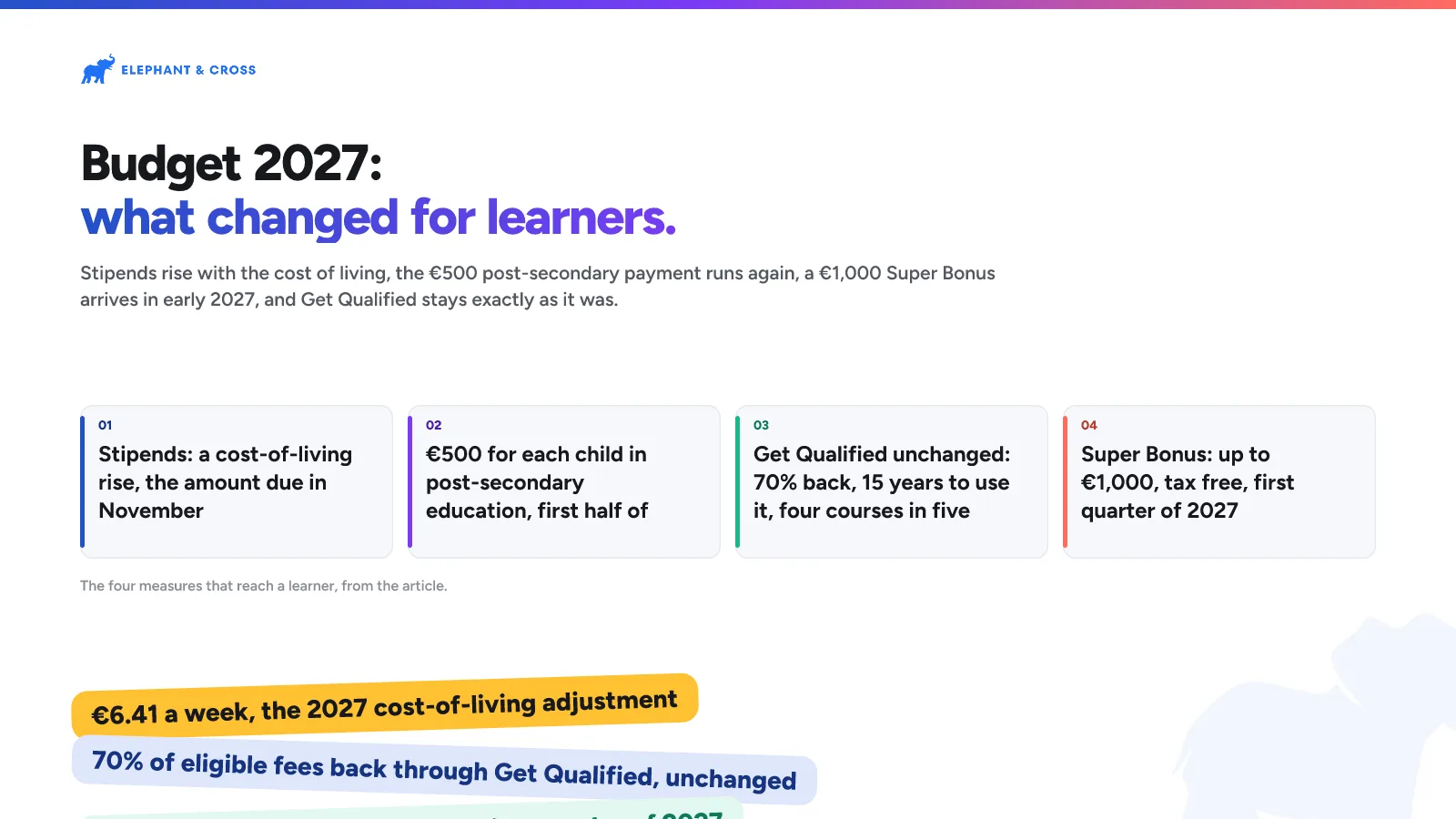
Budget 2027 was read in Parliament on 26 October 2026. For anyone studying, or paying for a course while working, four things changed and one did not. Stipends rise with the cost of living and reach two new groups. The €500 payment for each child in post-secondary education runs again. A tax-free Super Bonus of up to €1,000 arrives in the first quarter of 2027. The tax-free band for working parents widens. Get Qualified was not mentioned, which means the 2026 rules carry on. This guide sets out each measure, who it reaches, when it pays, and what it changes if you study online around a job. Our pre-budget guide has the asks that went in; this one has what came out.
The short version
| Measure | What changed | Who it reaches | When | Source |
|---|---|---|---|---|
| Student stipends | Rise in line with the cost of living; new stipends for maritime students and trainee pilots. The amount is not yet published | Full-time students at Maltese post-secondary and tertiary institutions | Details due in November 2026 | Malta Independent, Newsbook |
| €500 post-secondary payment | Continues for about 14,000 families. Third and final instalment for families first eligible in 2025, second for 2026, first for new entrants | Parents of children in post-secondary education | First half of 2027 | MaltaToday, KPMG |
| Get Qualified | No change. The 2026 scheme stands: up to 70% of eligible fees back as a tax credit, 15 years to use it, four courses in five years | Anyone completing an eligible course | Ongoing | Malta Enterprise |
| Super Bonus | Up to €1,000, tax free, on 2025 employment income. €1,000 from €12,000 up; €500 to €925 between €2,000 and €11,999 | Employees, the self-employed, part-timers and working pensioners | First quarter of 2027, by cheque | TVM |
| Cost of living and the minimum wage | COLA of €6.41 a week; the minimum wage rises €10.41 a week including COLA and stays untaxed | Every employee | 1 January 2027 | TVM |
| Parents’ income tax | No tax on the first €24,000 each for working parents with two or more children, up from €18,500; €16,000 with one child, up from €14,500. The bands rise again in 2028 | Parents taxed under the parent or married computation | 2027 income, rising again for 2028 | MaltaToday |
| Pensions | €10 a week more, including COLA; the tax-free pension income rises by €520 to €37,624 | Pensioners, including those who still work | January 2027 | TVM |
The official speech, estimates and economic survey are on the Ministry for Finance’s Budget 2027 page. This year the Finance Minister did not read every measure himself: ministries are announcing their own measures through November, which is why the stipend figure is still open.
Stipends: a cost-of-living rise, and two new groups
The speech on 26 October said nothing about stipends. The next day the Ministry for Education confirmed that they will rise, and on 30 October the Education Minister said the rise will be in line with the cost-of-living adjustment. Two groups that had no stipend get one: students in the maritime sector and people training for a pilot’s licence. The euro amount, the start date and the new eligibility rules are still to be published.
For scale, the 2027 cost-of-living adjustment for wages is €6.41 a week. Last year’s rise was different in kind: every stipend went up by 15% from the payment of 25 February 2026, reaching around 16,600 students at a cost of about €6 million. Labour’s 2026 manifesto promised a second 15%; what has been announced for 2027 is a cost-of-living adjustment, and the manifesto figure has not been confirmed.
Two dates still stand whatever the amount turns out to be. Applications made by 31 December 2026 are paid from the start of the academic year; a later application counts from the day it is made. The 2026/27 payment calendar starts on 2 December 2026 and runs to 4 November 2027. Our stipends guide has the rates by course and the application steps, and we will add the new figure the day it is published.
Stipends are paid to full-time students at Maltese institutions. If you study a UK diploma online around a job, the stipend is not your measure. Get Qualified is.
The €500 post-secondary payment runs again
Families receive €500 for each child in post-secondary education in the first half of 2027, a payment that reaches about 14,000 families. It is paid to the parent, not the student, and it follows the three-year pattern set when it was introduced: for families first eligible in 2025 this is the third and final instalment, for those first eligible in 2026 the second, and for new entrants the first.
Two smaller measures sit alongside it. Young people leaving care get financial support from 17 to 21, paid on top of any stipend and set at no less than social assistance for a single person, with guaranteed access to education and training. Young people in rehabilitation who train for a trade or find work receive social security contribution credits for that period.
Get Qualified: nothing changed, which is the news
The speech did not mention Get Qualified, and the Prime Minister closed the evening by saying that measures from previous years not mentioned in the speech are retained. So the scheme that Malta Enterprise relaunched on 6 April 2026 runs on unchanged into 2027: up to 70% of eligible course fees back as a tax credit on awards gained from 1 January 2026, 15 years to use the credit, up to four courses in any five-year period, and an attainment bonus on top for the STEM awards and higher degrees Malta Enterprise lists.
In money, for the course most of our students take: a Level 5 diploma at €220 a month over 18 months costs €3,960. Up to €2,772 of that comes back as a tax credit, which leaves €1,188. The credit is claimed once you hold the certificate, and the application goes in within 12 months of the award. The Get Qualified guide walks through the claim, and the STEM bonus guide covers which awards earn the extra.
One deadline from the relaunch is close. If you started a course in 2025 and want to be assessed under the 2017 to 2025 rules instead of the new ones, Malta Enterprise needs that request in writing by 31 December 2026, with the certificate and the financial documents in hand by 31 December 2030.
The Super Bonus, and what €1,000 buys a learner
Everyone who worked in 2025 gets a tax-free Super Bonus in the first quarter of 2027, paid by cheque. Employment income of €12,000 or more in 2025 earns the full €1,000. Income between €2,000 and €11,999 earns a pro-rata amount from €500 to €925. The self-employed, part-time workers and pensioners who kept working are included. The detailed rules, including how the pro-rata bands are cut, had not been published on budget night.
Set against a course, €1,000 is four and a half months of a €220-a-month diploma. Set against the €1,188 a Level 5 diploma leaves after the Get Qualified credit, the bonus covers most of it. The two measures were not designed together, but for a working adult who finishes a diploma in 2027 they land in the same year.
Pay, tax and the household: the numbers that move in January
The cost-of-living adjustment for 2027 is €6.41 a week. The national minimum wage rises by €10.41 a week including that adjustment, and minimum-wage earners still pay no income tax. The additional cost-of-living mechanism for low and middle-income households continues, paying between €200 and €1,500 a year depending on income and household size. Pensions rise by €10 a week including COLA, and the pension income that can be received free of tax rises by €520 to €37,624. National Insurance contributions can be transferred between spouses, a change the government expects to benefit a further 3,200 married women.
The largest change for a working household is the tax-free band for parents, which widens in 2027 and again in 2028. The figures below are the thresholds read out in the speech, with the maximum saving each one gives.
| Household | Tax-free band in 2026 | 2027 | 2028 | Maximum saving |
|---|---|---|---|---|
| Married computation, one child | €17,500 | €20,000 | €22,500 | €725, then €1,450, then €2,175 |
| Both parents working, one child | €14,500 | €16,000 | €18,000 | Per parent: €575, then €1,150, then €1,800 |
| Married computation, two or more children | €22,500 | €30,000 | €37,000 | €2,025, then €4,050, then €6,000 |
| Both parents working, two or more children | €18,500 | €24,000 | €30,000 | Per parent: €1,625, then €3,250, then €5,000 |
The last row is the one most of our students sit in: two working parents with two children each pay no tax on their first €24,000 of 2027 income, and on their first €30,000 of 2028 income. The government puts about 29,300 parents in that group.
What was not in it
There is no new measure for training at work. The Malta Chamber had asked for a tax credit on the cost of training staff and Malta Employers for a national AI upskilling fund, both set out in our pre-budget guide. Neither appeared. Spunt’s fact-check of the claim that “there were no schemes to incentivise the upskilling of workers” rated it mostly true. What businesses did get is a 25% tax rate, down from 35%, on profits that companies with a turnover of up to €1 million keep or reinvest; dividends stay at 35%. For a working adult, the practical effect is unchanged: the claim for a course still runs through the individual, under Get Qualified, not through the employer.
The second 15% rise in stipends from Labour’s manifesto was not announced. Get Qualified’s caps, levels and percentages were not touched. And for workers from outside the EU, the cost of staying falls on the employer’s side: the fee for a new work permit rises from €600 to €800, and a new €400 annual contribution applies to new permits and renewals.
The dates a learner lives by
| Date | What happens | Who it concerns |
|---|---|---|
| November 2026 | Ministries announce the measures left out of the speech, including the stipend amount and the new eligibility rules | Stipend holders, maritime students, trainee pilots |
| 2 December 2026 | The 2026/27 stipend payment calendar begins | Full-time students |
| 31 December 2026 | Last day to apply for a stipend and be paid from the start of the academic year | Full-time students |
| 31 December 2026 | Last day to ask Malta Enterprise, in writing, for the 2017 to 2025 Get Qualified rules on a course started in 2025 | Anyone who started a course in 2025 |
| 1 January 2027 | COLA of €6.41 a week, the minimum wage up €10.41 a week, pensions up €10 a week, and the new parents’ tax-free bands apply to 2027 income | Every employee, pensioner and parent |
| January to March 2027 | The Super Bonus cheques of up to €1,000 go out | Everyone who earned employment income in 2025 |
| First half of 2027 | The €500 post-secondary payment is made | About 14,000 families |
| Within 12 months of your award | The Get Qualified application goes in | Anyone finishing an eligible course |
What this means if you study while working
The budget left the adult learner’s arithmetic where it was and added cash around it. A Level 5 diploma still costs €220 a month and still comes back at up to 70% through Get Qualified. The Super Bonus, the wider parents’ band and the €500 payment for a child in post-secondary education all arrive in the first half of 2027, which is when most people who enrol this winter are halfway through. Nothing in the speech makes waiting pay: the one measure a part-time online student can claim, Get Qualified, is the one measure that did not move.
The Level 5 diplomas that qualify are listed by subject, with the price and the Get Qualified refund shown on each course page. The full list is on our courses page.
Questions learners are asking
Did Budget 2027 change Get Qualified? No. The scheme was not mentioned, and measures from previous years that were not mentioned are retained. The 2026 rules apply: up to 70% of eligible fees as a tax credit, 15 years to use it, four courses in any five-year period.
How much will stipends rise? The figure is not yet published. The Education Minister said the rise is in line with the cost-of-living adjustment, which is €6.41 a week for wages in 2027, and that the details follow in November. Last year’s rise was 15%.
Who gets the €500 post-secondary payment, and when? Parents of children in post-secondary education, around 14,000 families, in the first half of 2027. Families first eligible in 2025 receive their third and final instalment; new entrants receive their first.
Who gets the €1,000 Super Bonus? Anyone with employment income in 2025, including the self-employed, part-timers and working pensioners. Income of €12,000 or more earns the full €1,000; between €2,000 and €11,999 the payment is pro rata, from €500 to €925. It is tax free and paid by cheque in the first quarter of 2027.
Is there a new tax credit for training at work? No. No employer training credit or upskilling fund was announced. The route for a working adult is still Get Qualified, claimed by the student after the award.
Should I wait for the stipend announcement before enrolling? Only if you are a full-time student at a Maltese institution, because the stipend applies to you. If you study a UK diploma online around a job, the stipend does not apply and the scheme that does, Get Qualified, has not changed.
Your next step
Read our Get Qualified guide to see how much of your course fees comes back, and how the claim works once you finish.